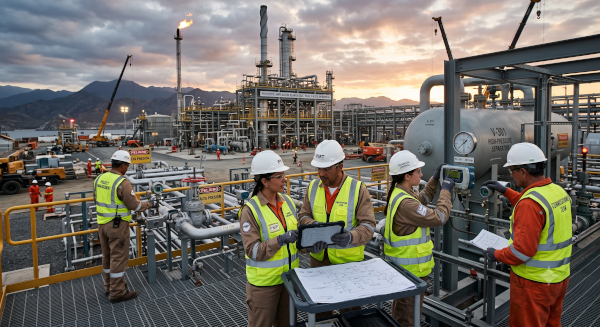
Project management in the oil and gas sector: construction, technical control, and commissioning.
Project management in the Oil & Gas sector is a demanding task where every decision directly impacts safety, assembly quality, and the operational performance of the facilities. With a clear, practical approach, this article outlines the project's full lifecycle: it begins with the engineering and planning stage—defining scope, schedules, resources, interdisciplinary interfaces, and technical requirements; proceeds to the coordination of field work fronts to ensure construction and assembly meet specifications; and concludes with the inspection, testing, and commissioning phase, where the system is validated against the requirements set out in drawings, standards, and procedures.
Along the way, the article addresses the elements that make this sector unique: the complexity of piping and equipment systems (pipelines, lines, valves, connections, joints, supports, and drainage); instrumentation and control (measurement, signaling, and protection); and the subsystems that ensure safe operation (grounding, venting and flare systems, hot work safety conditions, and energy control). It also highlights fundamental practices such as developing and monitoring Quality, Inspection, and Test Plans (ITP); verifying critical documentation; controlling dimensions and materials; tracking activities; and maintaining compliance records that provide technical proof of correct execution at every stage.
The reader is guided through a process that goes beyond theory, describing how typical tests are organized, how system integrity is verified before startup, and how the transition to stable operation is managed. Furthermore, the text explains why safety is not an afterthought but a continuous priority—spanning everything from risk planning, permits, and procedures to field assurance through inspections, reporting, and corrective actions where necessary. Finally, it looks toward the asset's operational future, emphasizing the importance of operation and maintenance planning in preserving performance, minimizing unplanned downtime, and anticipating potential failures. Overall, this publication offers a comprehensive and engaging overview of how oil and gas facilities are constructed and commissioned, applying technical standards, structured workflows, a focus on quality, and a genuine commitment to safety.